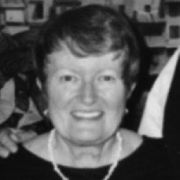
JOSEPH FINK, ASH, BSI
Remembering Tonga (BSI: The Martyrdom of Man)
by Joe Moran
I first met Joe Fink at the 1988 Autumn in Baker Street gathering. I was the speaker who preceded Joe’s presentation of his treatise on Dr. Watson’s Dumber Brother. (Ever since, I have been eternally grateful to Bob Thomalen for not scheduling me to go on after Joe had left his audience rolling in the aisles with laughter.)
Joe’s self-effacing manner camouflaged the fact that he had graduate degrees from Columbia and NYU in chemical engineering and business management and had been a professor at Fairleigh Dickinson University. Even more surprising to some was Joe’s status as a business tycoon. At the time of his death, he was still active as the CEO of Plastident, a defense contractor which supplied our armed forces with vital protection against such military hazards as athlete’s foot.
With his background as a scientist and scholar, Joe brought to the Sherlockian world an immense capacity for imaginative use of research sources that had escaped the attention of others. His many contributions to our lore capitalized on his ability to find pertinent subject matter in such unfamiliar writings as “I Washed Oscar Wilde” and “Great Men of Garbage and the Women Who Love Them.”
Joe was also a conscientious historian, reporting on the lives of Albertus Magnus and other historical figures outside the Sherlockian world, as well as persons more directly related to our interest in Sherlock Holmes. Joe’s writings are replete with such memorable characters as No-Nose Nussbaum (a one-time major league pitcher), T.T. Cratchit (the jockey decapitated while riding Silver Blaze), and the Maharajah of Yom Kapoor (who led a tribe afflicted by flat feet).
Joe’s own long-term physical ailments may help explain why his writings contain so many references to unusual diseases, bizarre medical treatments, and various forms of bodily dismemberment. Joe obviously empathized with the victims of such problems. As Executive Director of the Dwarf Defense League, Joe also spoke out for the interests of Tonga, the Andaman Islander, and everyone else of small physical stature.
Joe Fink will be sorely missed by all who heard him or read his work—and especially by those of us who knew him.
A Not-So-Trifling Monograph on the Origins of ASH
Editors’ note: In Joe’s memory, we’d like to share an excerpt from one of his ASH Dinner presentations.
Delivered at the ASH Spring Dinner on 6 April 1991 and published in The Serpentine Muse vol 9, no 4.
My fellow Sherlockians,
[JF: “It’s one thing to read your notes when you’re sober.”
Voice from audience: “But none of us has ever tried that.”]
Once upon a time in 1934, an unexplained spirit moved a group of men to pay tribute to the Master. They gathered annually in New York thereafter, these male members, and went forth and became good men of the Canon. For thirty years they rejoiced and prospered as Baker Street Irregulars, these sons of Holmes. Then suddenly in a second haven in a second state a strange phenomenon occurred. A spirit moved another group — a flock of females — to pay homage to Sweet Sherlock. This maculate conception took place at a most unlikely spot — a school for unwed women in the midst of Connecticut. After much soul searching and divine exultation, including a visit with the head of the Baker Street Irregulars for divine guidance, the titular head of this august body announced that the group had chosen a name. It was, of course, The Adventuresses of Sherlock Holmes and the acronym A.S.H., or ASH.
[Cheers]
Now, in recent years, in the depths of the night, I would awake and think deeply about the original ladies of ASH. What caused them to receive their calling? Could I trace the roots of their virtuous transgression? Driven to resolve this issue, I made a fateful decision: I crossed the border into Connecticut to see what I could uncover at their college grounds. Identifying myself as a Baker Street Irregular, which drew a rather incredulous response from the head librarian, I was permitted to enter the school’s historical vault in the research library’s lower chamber. The results of my inquiry are quite astonishing. But let me assure you that all the facts are true!
On July 7, 1930, the famous literary agent Sir Arthur Conan Doyle died. Seventeen months later, on December 16, 1931, Pope Pius XI canonized as a saint of the Church the greatest figure of his century.
- He was a chemist, detective, writer, musician.
- He had an imposing, long nose and was given to magical powers of observation.
- He was an admirable companion to his doctor-biographer-best friend.
- A bachelor, he was devoted to one woman only and dubious about all others.
- He was a celebrated beekeeper and solver of divine mysteries.
- He wore a funny hat.
- He was Albert of Bollstadt, known to the world as Albertus Magnus or Albert the Great.
Ten years after his canonization, in 1941, Pope Pius XII declared Albertus the patron saint of all scientists, including forensic detectives. The school that gave birth to the Adventuresses of Sherlock Holmes, is, of course, Albertus Magnus College in New Haven, Connecticut.
Given the duality between Albert and Sherlock, the calling to Holmes as a contemporary counterpart of their Alma Pater perhaps was inevitable.
Albert was indeed a 13th Century forerunner of Sherlock Holmes. In his physical and intellectual life, he bore a striking resemblance to the Master. Born in Swabia in 1193, he was educated at the University of Padua. It was, however, in Paris when he was in his early thirties that he spent his most productive non-clerical years. It was here that this teacher, with a hawk-like visage and piercing eyes, met his pupil, Thomas Aquinas, a short portly fellow who was soon to become his biographer and a Doctor of the Church.
[Audience: cackles.
JF: “It’s a true story: what do you want from me?”]
Big Al and Little Tom became inseparable, with Thomas always carrying a pencil and paper when in Albert’s presence in order to record his most remarkable observations.
Editors’ note: and the paper went on from there…
Thanks, Joe, we’ll always remember you with a smile.