2010 JAN WHIMSEY AWARD
Philip Shreffler, “Toast to Sir Arthur Conan Doyle.” The Serpentine Muse Vol. 25, No 4, 2010, pp 22-23.
A TOAST TO SIR ARTHUR CONAN DOYLE
by Philip A. Shreffler
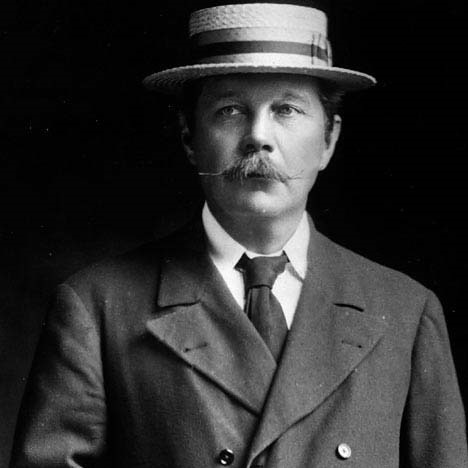
This year, 2009, is held to be remarkable because it is the sesquicentennial of the birth of Sir Arthur Conan Doyle—although they really didn’t call him “sir” when he was born, unless they were awfully deferential in the midwifery racket in those days. Now it is commonly believed that to celebrate the births of great men and women is to commemorate their lives and accomplishments, and I suppose there’s some sense in it. After all, had Sir Arthur not been born, someone else would have had to write the Sherlock Holmes stories—say, Dr. Watson or somebody. But as far as being born is concerned, that’s not such an august accomplishment. I’ve done it myself.

No, what we celebrate here tonight is Sir Arthur’s involvement in the life of the Master of Baker Street—whether the former were creator of the latter or amanuensis of another who chronicled the latter’s adventures. And considering things from that perspective, the mathematics are a bit more complex than simply subtracting 1859 from 2009 (though that was challenging enough that I had to do it on a scrap of paper just to make sure I got 150 and that the word “sesquicentennial,” which I also looked up for safety’s sake, was correct).
You see, what makes better sense is what Sherlockians spend a lot of their time doing when looking for something to celebrate. That is to consider significant dates and events regarding Sherlock Holmes (and we can do so here with the assumption that Sir Arthur tagged along for the ride). Now chronologists seem to agree that Holmes and Watson met and investigated their first case together in 1881. 2009 minus 1881 (I’ve gone to a calculator now; it’s simpler) equals 128, which is certainly the multiple of something, but doesn’t even have a respectable whole-number square root. That adventure, STUD, was published in 1887, which date, subtracted from 2009, yields 122, provocative because it is 221 in reverse. But do remember that Holmes’s address is 221B. Assigning the number 2 for the letter B, as one naturally would, results in 2,212, not very useful even if we reverse it again to read 2,122, and it’s giving me a headache just to read this. Now if Sherlock Holmes had died in 1976, assuming that he was born in 1854, then he would have been exactly 122. But he didn’t, and this isn’t 1976 anyway.
The most logical course to pursue, then, is to consider what Holmes adventure was published in 1909 and see if we can squeeze at least a centennial out of all this. However, this results in the curious incident of the author who did nothing during writing-time. BRUC was published in The Strand in December of 1908, followed by DEVI in December of 1910. Follow me closely here, ladies and gentlemen: No Holmes story was published in 1909.
And I’ll tell you why. This is clearly a part of the sinister and convoluted Da Doyle Code, a plot so fiendishly clever that Sherlockians have been utterly unaware of it—until now. Sir Arthur built into the publication dates of the Holmes stories absolute inevitabilities that would have unprincipled even Heisenberg. By giving 1909 a miss, Sir Arthur deliberately left us with nothing to mark with alarums and flourishes in 2009 except the sesquicentennial of his birth, drawing our attention quite away from Sherlock Holmes—as was always his wish before he and his ectoplasm oozed off to the spirit world.
And so, Sir Arthur, you’ve got us. A toast to you at 150!